elephants in the fog: a film experience
the film opens at night. villagers walk along the edge of the forest holding fire, trying to drive away wild elephants, and while they do it they chant in bhojpuri; “oh mighty elephant, do not cross this sacred line.” that line is the one the film keeps coming back to.
elephants in the fog won the jury prize in un certain regard at cannes this year. it's abinash bikram shah's first film as a director, and it follows a kinnar household in thori, birgunj.
the villagers treat the elephants as sacred, and they're also afraid of them, enough to patrol every night with fire. over the course of the film you see that they treat the kinnars in much the same way. early on, the kinnars bless a pregnant woman in the village. they're brought in and paid to perform at weddings, and their clapping is supposed to bring good luck. people want that luck. they just don't want the kinnars living next door, and when one of them disappears nobody seems to care very much.
i didn't connect the two until a while into the film. the opening scene just looks like a village problem: elephants come near, so people light fires and shout at them. it's only after the blessing and the wedding scenes that you notice the same attitude toward the kinnars. the village needs them on certain occasions and keeps its distance the rest of the time.
most films, when they’re trying to madhesh, they show the heat, the poverty, the thatched huts, the local gangsters, the border and the violence. and while those things do exist as a part of madhesh, this film tries a different approach. the fog sits low over the plains at night, the ct rickshaws are just part of the background, and the way the characters talk to each other tells you where you are. people outside the region often don't believe the terai gets this cold. the film never says "this is the terai." it puts the characters there and let them define the place.
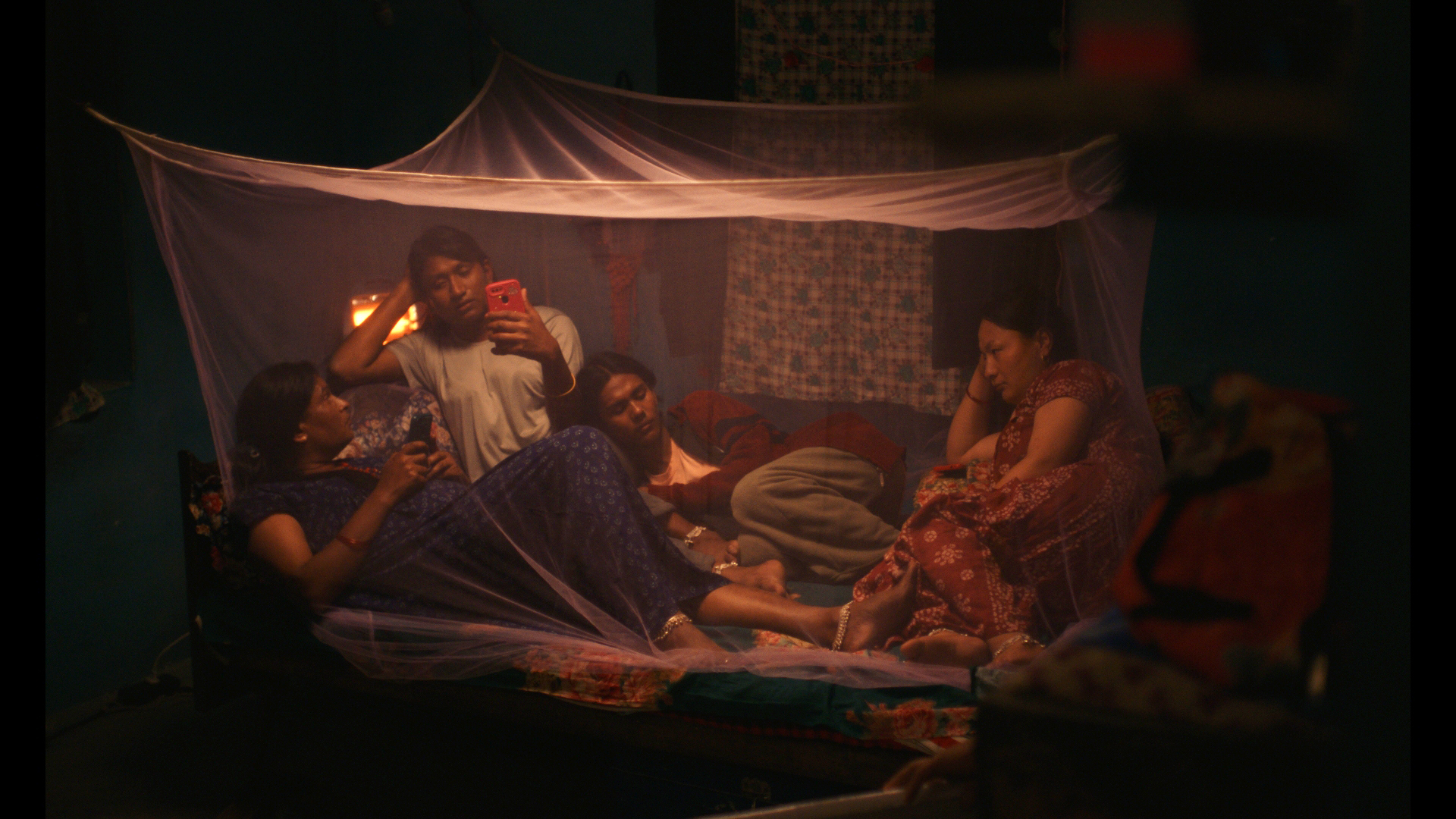
pirati is the mother of the house. the others are her adopted daughters, not related to her by birth, and apsara is the youngest. pirati is also in love with a dholak player, the drum master, whom she calls junge, and they're planning to leave for delhi together. that would mean leaving the house she looks after. she also knows herbs and makes medicines, which the film shows several times and everytime while something else is happening in the film. i liked that, because it tells you something about her without building a scene around it.

one night apsara goes out with the villagers to drive away the elephants but doesn't return. most of the film after that is pirati looking for her.
the film treats pirati as apsara's mother without ever arguing the point, which is why the hospital scene is the one i'd point to first. a body has been found in the forest and it might be apsara's, so pirati goes to see it and is told that only blood relatives are allowed. she's the person who raised apsara, and the hospital has no place for that. when she keeps pushing, the doctor answers by saying the body is a man's, as if that settles whether she has the right to see it. the scene is short, and it says more about how she's treated than a longer one would have.
the police aren't any better. when pirati goes to them for help she gets insulted instead. her landlord wants her out of the room while she's still searching, and when she asks what he would do if his own daughter had disappeared, a woman standing nearby says apsara can't be compared to his daughter. the film doesn't comment on any of this. people just speak to her that way, in the middle of a search for someone she loves, and nobody on screen treats it as unusual.
what i didn't expect is that the film also looks at the kinnar community from the inside, and not always kindly. there's a hierarchy, with a guru above pirati whom the whole community answers to, and there are rules about what members owe the family, with consequences for breaking them. pirati runs the house and isn't exempt from any of it. a film trying to be progressive in the safest way would probably have shown only the good side of the community, and this one doesn't. i thought that was the more honest choice, and it made the people feel more real to me than if the film had only shown them being wronged.
the camera work is the other thing i want to talk about. in the scene where pirati goes into the forest to look for apsara, the camera doesn't cut between her face and whatever she's looking at. it pans on its own, the way her head would turn, so you end up searching the forest along with her. noé bach shot the film. there are a lot of close-ups, and the faces carry a lot of what the dialogue doesn't say. the colors are mostly cold blue and dim light, and in a few scenes the camera shakes when the characters are in a bad state.
the sound works well too. you hear the elephants, the forest at night, and the kinnars' clapping, which is used almost like an instrument. ranzen jha's score mostly stays in the background and i barely noticed it as music, which i mean as a compliment. there's a devotional song during the blessing scenes that i liked a lot. the bhojpuri kinnar folk songs are placed well, but i thought the balance between how raw they sound and how clean the recording is could have been better.
the dj scene is where i changed my mind while watching. the song is loud and distorted, and for a second i wanted to cover my ears. then i remembered what the dj setups at weddings in madhesh are actually like. they actually are that loud and that chaotic, so the scene is just accurate. i'd had it backwards, and the film hadn't.
i won't describe the ending. i'll only say that the clapping, which we've seen all film as a blessing and as something the kinnars are hired to do at weddings, ends up being used for something else, and the fence past the village doesn't hold.
i do have problems with the film. after apsara disappears it moves into something closer to an investigation, and parts of the second half felt like a standard procedural, which didn't sit well with how slow and quiet the first half is. the police and the search start to follow a familiar pattern, and i found myself less interested in the plot than in the individual scenes around it. apsara is also hardly a character. the whole plot depends on her and we learn very little about her. it might be deliberate, since she's mostly absent, but i can't decide whether that's a gap in the writing or the point.
i still think it's a good film. it's slow, and the second half doesn't fully hold up, but the hospital scene and the search in the forest are the parts i kept thinking about afterward. i'd recommend it to people who are fine with a slow film, and i'd tell them to expect that going in.